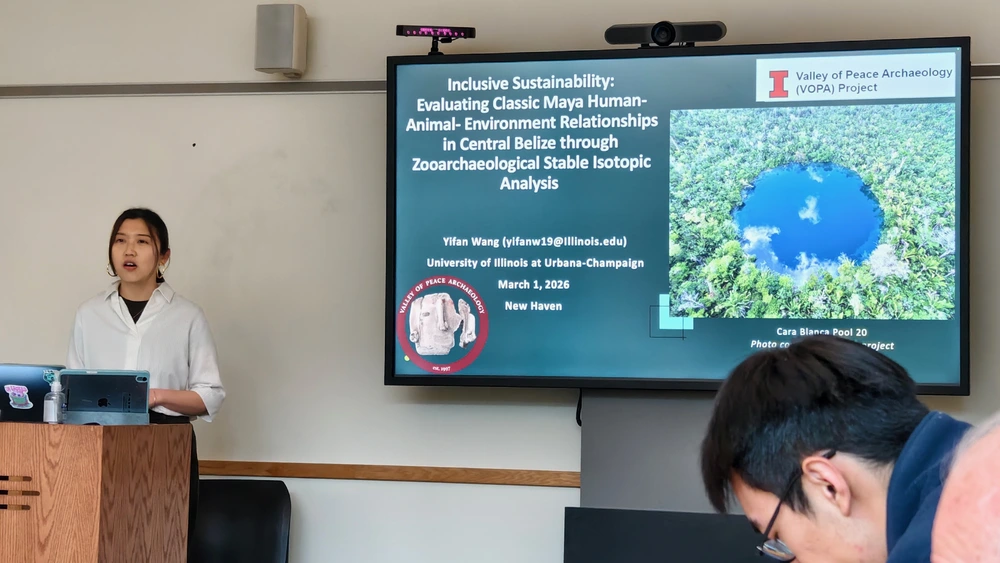
On March 3rd, Yifan Wang, an archaeology student in our department, spoke at a brown bag event at Yale University! Her lecture was titled "Inclusive Sustainability: Evaluating Classic Maya Human-Animal- Environment Relationships in Central Belize through Zooarchaeological Stable Isotopic Analysis". Congratulations on the successful lecture, Yifan!
Lecture Abstract: Ancient Maya socio-political transitions were closely entangled with regional environmental changes, as paleoclimatic instability from the Late Preclassic through the Terminal Classic (c. 100–900 CE) coincided with demographic shifts, urban reorganization, and, in the southern lowlands, political decline and diaspora during c. 750-900 CE. Yet climate alone does not explain divergent regional outcomes.
This study develops the concept of Indigenous Sustainability (IS) to examine how Maya communities adapted environmental stress through culturally embedded human–nonhuman–environment relationships. Drawing on multi-proxy zooarchaeological and isotopic analyses from the Valley of Peace Archaeology (VOPA) region in central Belize, including Yalbac, Cara Blanca, Saturday Creek, and associated farmsteads, I evaluate ecological resilience and sociocultural adaptation across contrasting settlements.
Zooarchaeological evidence reveals special human–animal interactions in ritual, mortuary, and residential contexts, including dual feline deposits, a grey fox burial, and armadillo scute offerings. Isotopic data indicate extended dry seasons and heightened climate variability during the Late and Terminal Classic. Despite these stresses, Saturday Creek maintained biodiversity and occupation into the 16th century CE, suggesting sustained adaptive strategies. In contrast, Yalbac exhibits reduced faunal diversity and resilience, leading to its abandonment during the Terminal Classic.