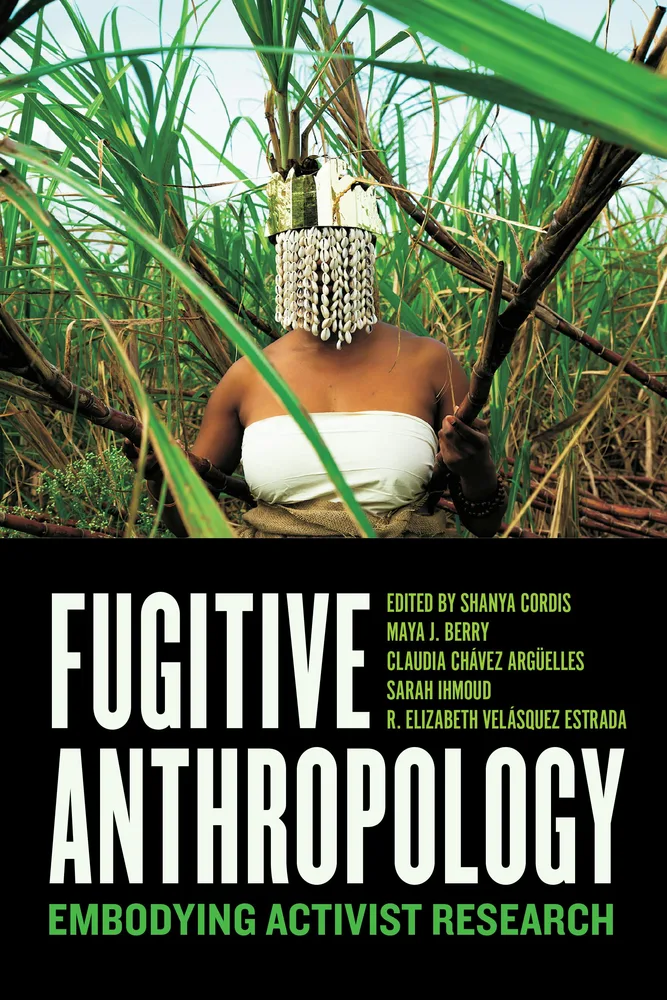
Congratulations to Dr. R. Elizabeth Velásquez Estrada on the recent publication of Fugitive Anthropology, a book she co-edited with Shanya Cordis, Maya J. Berry, Claudia Chávez Argüelles, and Sarah Ihmoud. The volume explores the power relations that racialized, gendered, and sexualized researchers grapple with while conducting activist research.
University of Texas Press describes this book:
A personal, provocative, and boundary-breaking volume on the power relations that racialized, gendered, and sexualized researchers grapple with while conducting activist research.
Fugitive Anthropology is a transnational, intergenerational engagement that extends feminist theory, activist research methodologies, and the discipline of anthropology in new directions. Contributors examine the tensions that arise from conducting politically engaged, collaborative research alongside communities in struggle, in particular theorizing from the experiences of racialized women, queer, trans, and gender nonconforming researchers across distinct geographies. Essays contend with the matrices of colonial, imperial, and patriarchal violence that afflict the researchers and communities with which they seek political alignment.
Articulating an ethnographic practice grounded in Black and Indigenous political struggles and committed to collective liberation, the volume reflects on what it means to navigate violent relations of power, systemic inequities, and current onslaughts shaping field research and US academia. Ultimately, Fugitive Anthropology argues that a feminist ethos—one that embraces embodied knowledges and fugitive sensibilities—forges liberatory spaces that break from dominant masculinist frames of the “political” and challenge colonial regimes within and beyond the neoliberal university.
You can purchase the book here: utpress.utexas.edu/9781477332733/