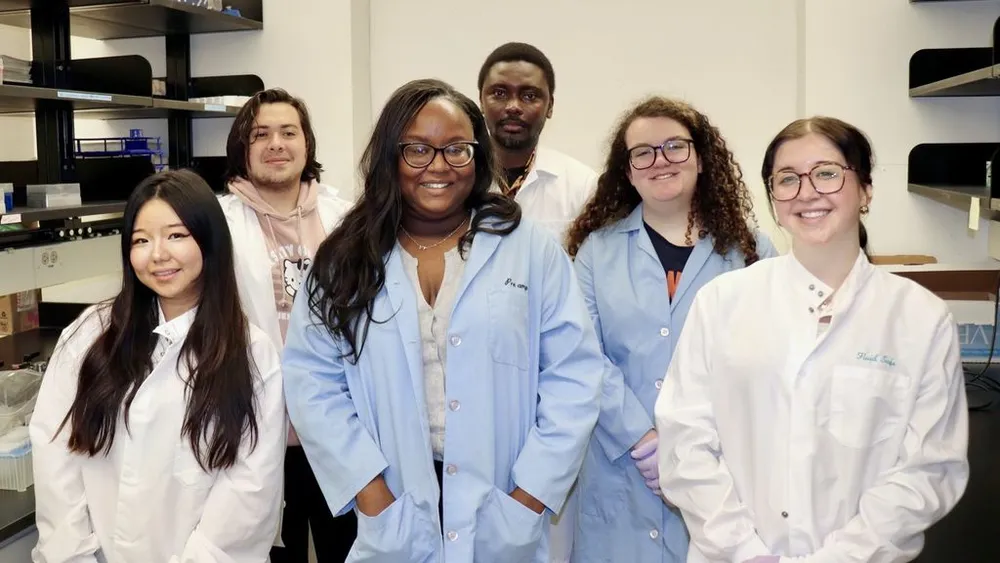
At 4 p.m. on a Wednesday, the lab was still quiet. Dr. Taiye Winful was preparing for the weekly session in the Biocultural Approaches to Stress and Health (BASHA) Lab. Over the next 15 minutes, students arrived one by one, setting up at the table, catching up in friendly conversation and introducing themselves to me. Five paths were converging in one room.
I wanted to learn how each of them got there and how the work is shaping their career plans. In five one-on-one conversations, what struck me most was that no two had arrived for the same reason or found their direction the same way.
Connecting human experiences with biology and health
The students’ career goals span medicine, health technology, veterinary medicine, counseling and community health. The projects share an anthropological question: how do people’s social and cultural experiences relate to their biology and health? To answer this, students must consider people’s lived experiences alongside biological evidence. The focus is on understanding those connections, rather than treating a measurement as a complete account of someone’s health or life. This is a uniquely anthropological perspective that centers on relationships, adding the human story to what health care can measure.
From classroom learning to research contributions
Shea Maloney, a senior in anthropology, is analyzing open-ended survey responses from a research project in Nigeria. Participants describe what “wahala,” a commonly used, stress-adjacent word in Nigeria, means to them and what they identify as its causes. Shea compares those accounts with biological measures of stress and inflammation.
Shea is interested in attending medical school and pursuing emergency medicine or obstetrics and gynecology.
“I wasn’t sure what major specifically for premed I wanted to do, and then I kind of just ended up in anthropology,” she said.
Through her own difficulty getting health information, she learned how other groups of women with different racial backgrounds were struggling even more with the same issue: getting care, and more importantly, good care, and being heard. That experience led her toward women’s health. Anthropology helped her connect her observations and interests to a path aligned with her future medical career.
Ellen Jo is a junior coming from the data science arena. She writes code, analyzes data and creates tables and visualizations.
What drew Ellen in was where technology meets biology. She explored that connection through an internship involving a diabetes-care product. Wanting to understand how that technology affects people led her to biological anthropology.
She described the value of working in a lab where she can see how data relates to people’s experiences. She is also doing hands-on lab work and enjoys building the skills that will guide her toward her planned future in health technology.
Building skills at the lab bench
Alongside data analysis, students learn the careful preparation needed to handle research materials. During the visit, Dr. Winful explained how students practice pipetting, a technique for transferring precise amounts of liquid. They check their accuracy before moving on to research samples and protocols such as DNA extraction and quantification, which some students have already begun.
Olivia Dire, a senior in animal sciences, was building those laboratory skills during the interview. Her interest in genetics led her to a class with Dr. Winful, and she wanted hands-on lab experience before graduating.
Olivia is considering research and veterinary medicine. “I knew I wanted to do research at some point in my life,” she said. Like many students, she found her interest in the classroom and followed it to the lab as her questions grew and deepened.
Connecting research with people’s lives
Liam Gallaga, a sophomore studying psychology and anthropology, is interested in how people’s social and cultural circumstances affect their biology. He is contributing to a paper examining how mothers’ experiences of care and support relate to biological aging. “I can see that person in their context,” he said. Liam is considering counseling or social work and hopes to carry that perspective into helping others.
For Prince Semanshia, a doctoral student in biological anthropology, understanding people’s circumstances is central to his interest in community health. His biomedical background and experiences in Ghana led him to question why people returned for care with recurring illness and how their well-being could be supported beyond treating disease.
Prince works on the Nigeria research project, studying ethnicity-related experiences and inflammation profiles, while also helping undergraduates with their laboratory work.
Prince sees his future in humanitarian or nonprofit work, focused on supporting health interventions in communities that need them and making health care more accessible. His north star is community well-being, and he plans to keep it at the center of his career.
Classroom to Careers: anthropology in action
Students in the lab have had the opportunity to present at conferences, and some have helped prepare manuscripts. These are Illinois students contributing to real research, not just reading about it at a desk. Anthropology in practice.
Working in the department, I see the breadth of anthropology every day. But sitting down with these students and hearing each of their experiences gave me a new grasp of just how far an anthropology degree can take you.
One thing was clear: they all had different trajectories and bright futures ahead. Each path is unfolding organically, shaped by exposure and life experiences.
Their stories show the value of being open, exploring and letting what you learn guide you at the forks in the road.
Explore these interests in Spring 2027
Interested in connecting anthropology with your own studies and future plans? Start with these courses in the Spring 2027 Anthropology schedule:
- ANTH 199 (Section A): Intro to Medical Anthropology: Explore how culture, biology and power shape the way people experience health, illness and healing (course details).
- ANTH 240: Biological Anthropology: Explore human evolution and biological variation, including genetics, primate behavior and human diversity (course details).
- ANTH 343: Behavior and Biology of Women: Examine female biology and behavior in evolutionary and cultural contexts (course details).
Ready for supervised research? ANTH 444: Methods in Bioanthropology and ANTH 445: Research in Bioanthropology are open with instructor approval (ANTH 444; ANTH 445).